Stepping onto a trail surrounded by gnarly Garry oaks can feel like you’ve entered a dreamy world of mosses, flowering plants, pollinators, and rocky outcrops where magic beings reside when you aren’t looking. But wait! What is that covering the branches of the Garry oaks? You look closer and realize, wow, there is a truly magical world hidden within this ecosystem- it’s the realm of lichens! The fuzzy bodies of Usnea species make a bold statement in the wintertime meadows of PKOLS, hanging off the leafless oaks in cascades of minty green hair. And if you take a moment to pause, lean in, and adjust the scale of your field of vision, you can start to notice more of the mysterious lichen species who call Garry Oak meadows home.
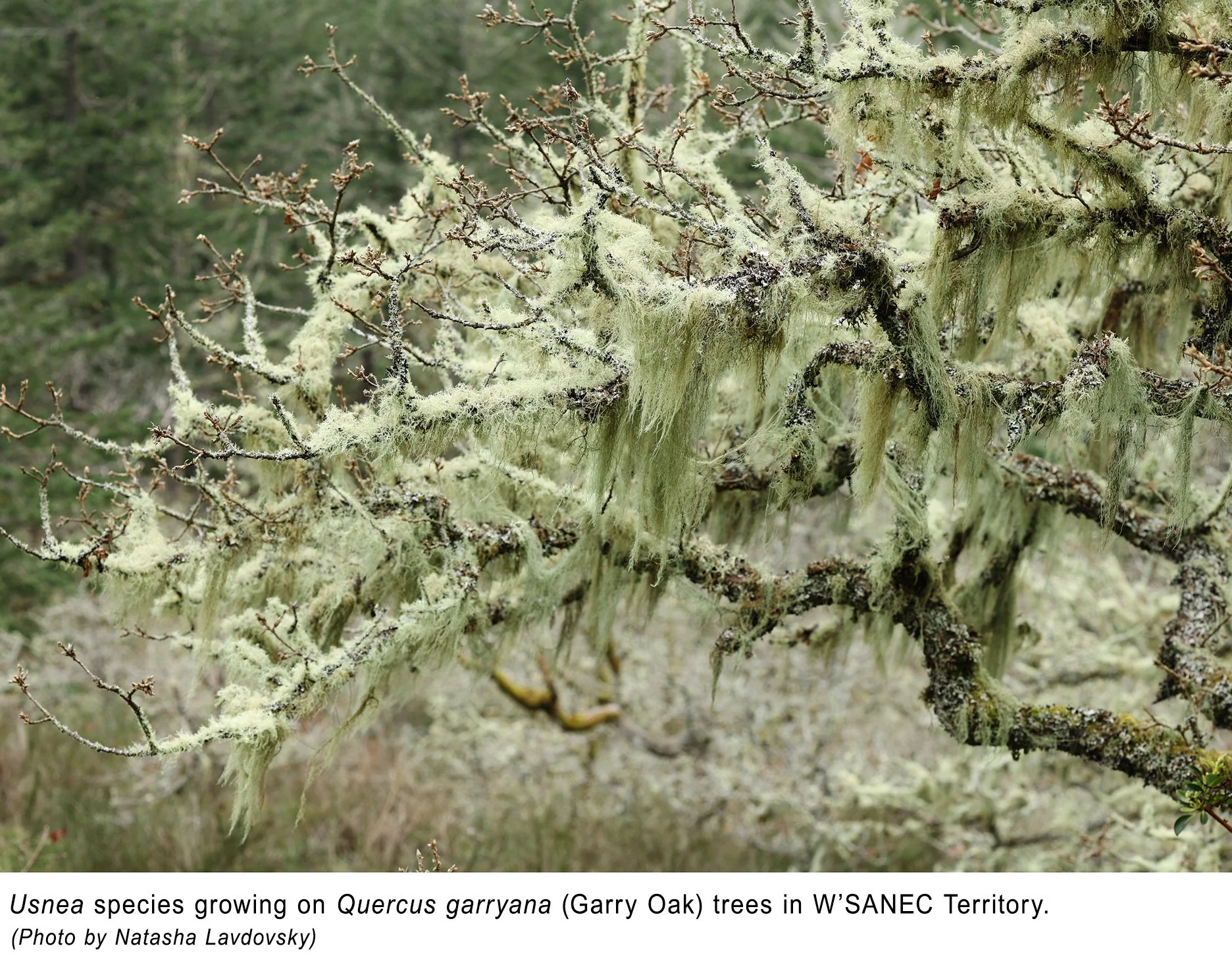
Lichens are a mutually symbiotic organism comprised of a fungus and a photosynthesizing partner (either a cyanobacteria, algae, or both). From here it is challenging to make generalized statements about lichen structure and symbiosis, since there is a diverse range of morphology and partnership arrangements amongst lichen symbionts. However, for the majority of lichen species, the fungal partner builds the body of the lichen, while the algae cells nestle under the top layer of fungal hyphae where they photosynthesize, making energy that feeds the fungus. In 2016, lichenologists discovered that every lichen they tested also contained yeast DNA, suggesting that yeast is a necessary contributor to lichenization. With multiple symbiotic partners within a single lichen, they really are a micro-ecosystem and subvert the very concept of a species. Furthermore, lichens have countless morphological growth forms: jelly lichens, crustose lichens, fruticose, foliose, dust lichens and even lichens that grow like seaweed on rocky shorelines.
Lichens benefit Garry oak ecosystems in many ways including: creating additional surface area for countless tiny critters (enriching the taxonomic diversity at the bottom of the food web), increasing humidity in the environment (since lichens are like little sponges), and providing a source of nitrogen to the soil (more on this below). A common myth about epiphytic lichens (that grow on trees or shrubs) is they cause their host plants to die. Not true! They don’t take any nutrients from their substrate, preferring to anchor themselves on the surface. You often see lichens on dead/bare branches because they are opportunists (most lichens love sunlight).
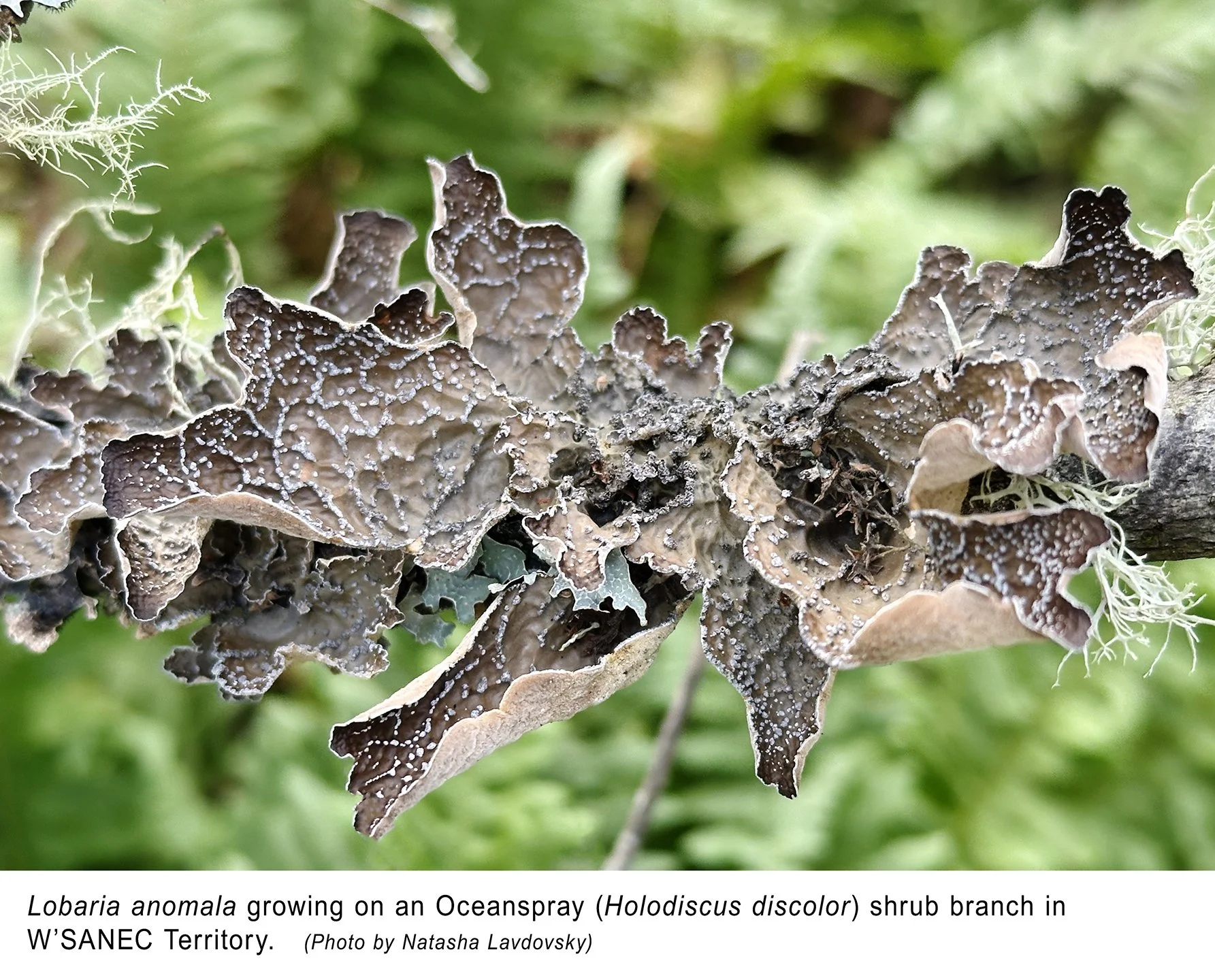
Here on Southern Vancouver Island we are in a hotspot for cyanolichens (lichens whose primary photobiont is Nostoc— a cyanobacteria, not an algae). Garry oaks and Ocean Spray are a favourite substrate for many cyanolichens, especially in W’SANEC Territory, away from Victoria’s downtown core (cyanolichens don’t tolerate air pollution). These lichens are especially ecologically valuable because their cyanobacteria fix nitrogen from the atmosphere and make it bioavailable to terrestrial species either when nitrogen-rich water drips out from the lichen or when they fall to the ground in a storm and their decomposing bodies slowly release nitrogen into the soil. But don’t take windfall lichens out of the meadows to fertilize your garden! Instead, leave them on the ground, get a hand lens, and peer into some low hanging branches to get lost in this delicate symbiotic realm.
Here is a list of conspicuous local cyanolichens to look out for on your next visit to a Garry oak ecosystem: Sticta limbata, Sticta gretae, Peltigera collina, Lobaria scrobiculata, Lobaria anomala, Lobaria pulmonaria (has both Nostoc cyanobacteria & green algae photobionts), Nephroma bellum, and Nephroma laevigatum.
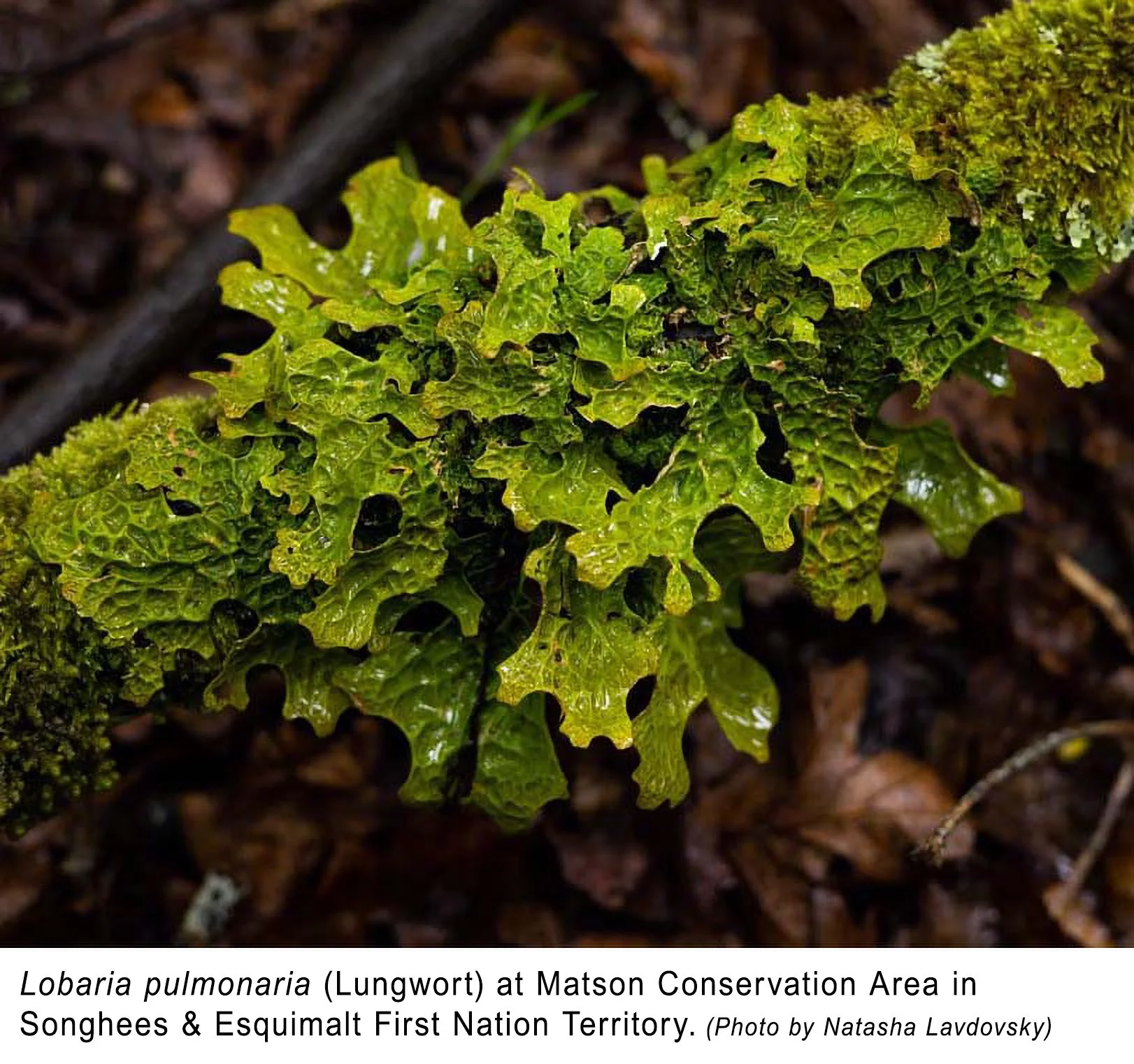
Though cyanolichens are very exciting, Garry Oak trees and nearby shrubs like Oceanspray also host many wonderful lichens whose photobionts are green algae. Some of the more common and easy to spot epiphytic lichens to familiarize yourself with are: Parmelia sulcata (and other Parmelia species), Platismatia glauca, Platismatia herrei, Punctelia jeckeri, Parmotrema arnoldii, various Usnea species, Evernia prunastri, Ramalina farinacea, Hypogymnia physodes, Ochrolecha laevigatum, Cetraria chlorophylla, Melanelixia glabratula, Physcia tenella, and Xanthoria polycarpa.
Becoming familiar with lichens has been a lesson on the power of perspective shifting, seeing overlooked nuances, and constantly accepting opportunities for humility when encountering something I am not familiar with. As an artist, I have practiced fine-tuning my recognition of variations in texture, shape, and colour tone. My interest in lichens began in 2011 when I was learning about ethnobotany, but my approach to lichens didn’t become rigorous until 2019 when I began learning which lichen species can be turned into textile dye (using windfall lichens from roadsides and lawns). This new passion evolved into a conceptual lichen sound project—sonifying lichen chemical data into soundscapes— that brought me to a number of sites around South Vancouver Island, including to the Fairy Creek blockade. I figured the blockade would be a great place to access the canopy ecosystem of recently felled old-growth trees for this lichen sound project (since the canopy is where much of the ancient forests’ species diversity resides). Before heading out, I asked a lichenologist colleague of mine if there are any at-risk lichens I should keep my eye out for while I was working on this project. Keeping a list of rare species in mind when visiting the Fairy Creek headwaters, I began to do a simple survey of the lichens living on a branch of an enormous old cedar that had fallen across a logging road. I soon came across a pale bluish grey foliose lichen with delicately curly edges and a light pink underside with raised whitish bumps. No way, I thought to myself, I think this is Pseudocyphellaria Rainierensis, the rare at-risk lichen I as just told about. So I took photos and when I returned home the next day I sent the details to 3 different lichenologists, Trevor Goward, Troy McMullin, and Bruce McCune, all of whom confirmed that yes, I indeed found Old-growth Specklebelly lichen— the first documented observation of the species on Southern Vancouver Island. In the following months, putting to use my undergrad training as a field scientist, I dedicated myself to documenting as many occurrences of this species in that forest as I could. By the end of my survey time up there (which was eventually impeded by the logging company and RCMP denying public entry to the access road 12km down the mountain) it turned out that I had stumbled upon the largest population of this blue-listed species-at-risk that had yet been recorded in Canada. The proposed cutblock (the chunk of ancient forest the logging company had already partly cut down- that the Fairy Creek blockade was trying to protect) had been sliced straight through the heart of this at-risk population of Old-growth Specklebelly lichen.
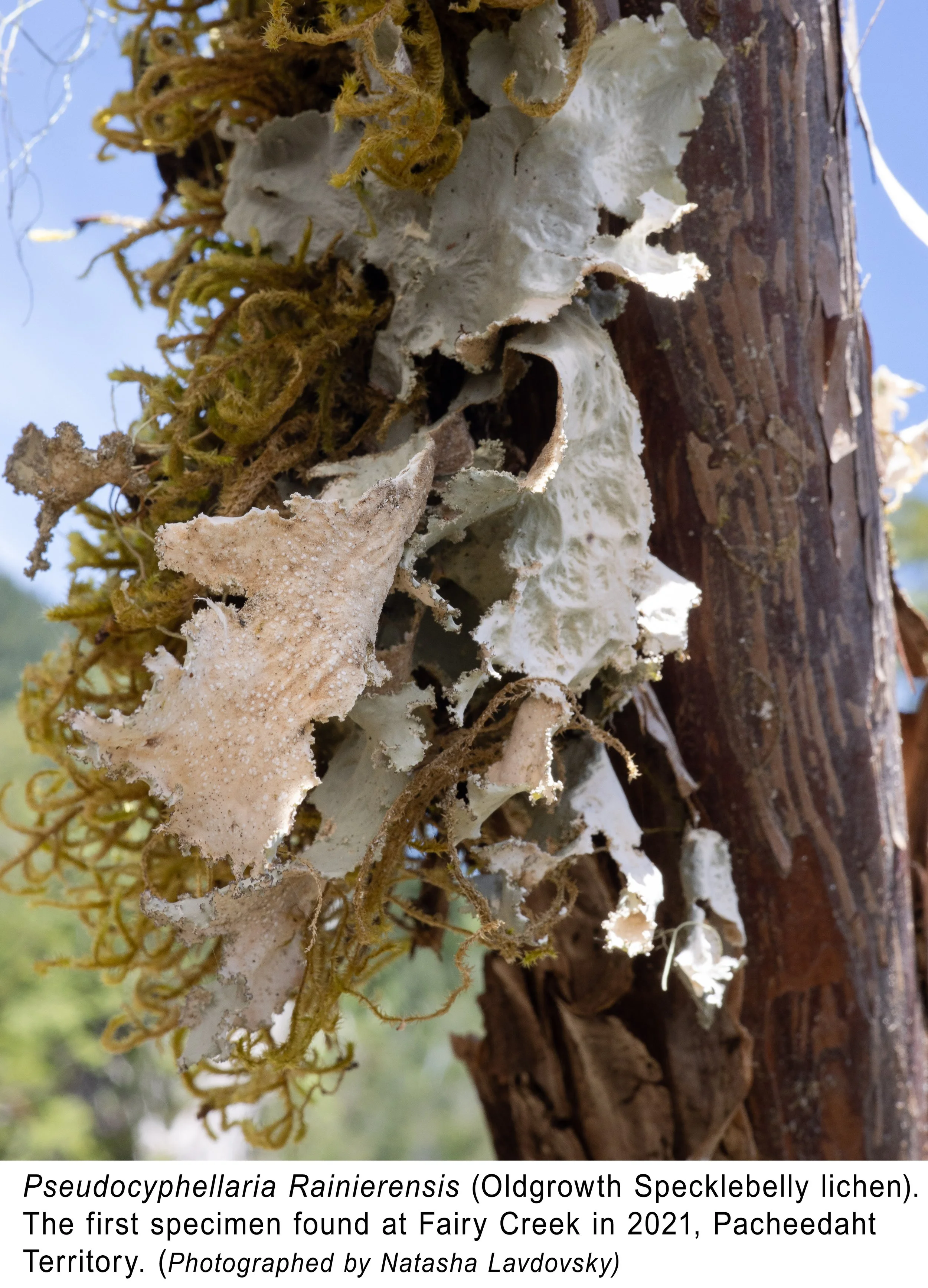
As a citizen scientist, I was aghast to see with my own eyes how there had been no heed paid to the presence of this species by the logging company, indicating a complete lack of biodiversity inventories before forests cutblocks are approved. Once the species was confirmed, I notified the Pacheedaht First Nation, the logging company, the Provincial Ministry of Forests, COSEWIC, news outlets, and the Fairy Creek blockade. I taught a few blockaders how to identify this rare lichen, in case they came across it in their future forest adventures. Since then, numerous populations of this lichen have been found across Vancouver Island where they have not been previously documented.
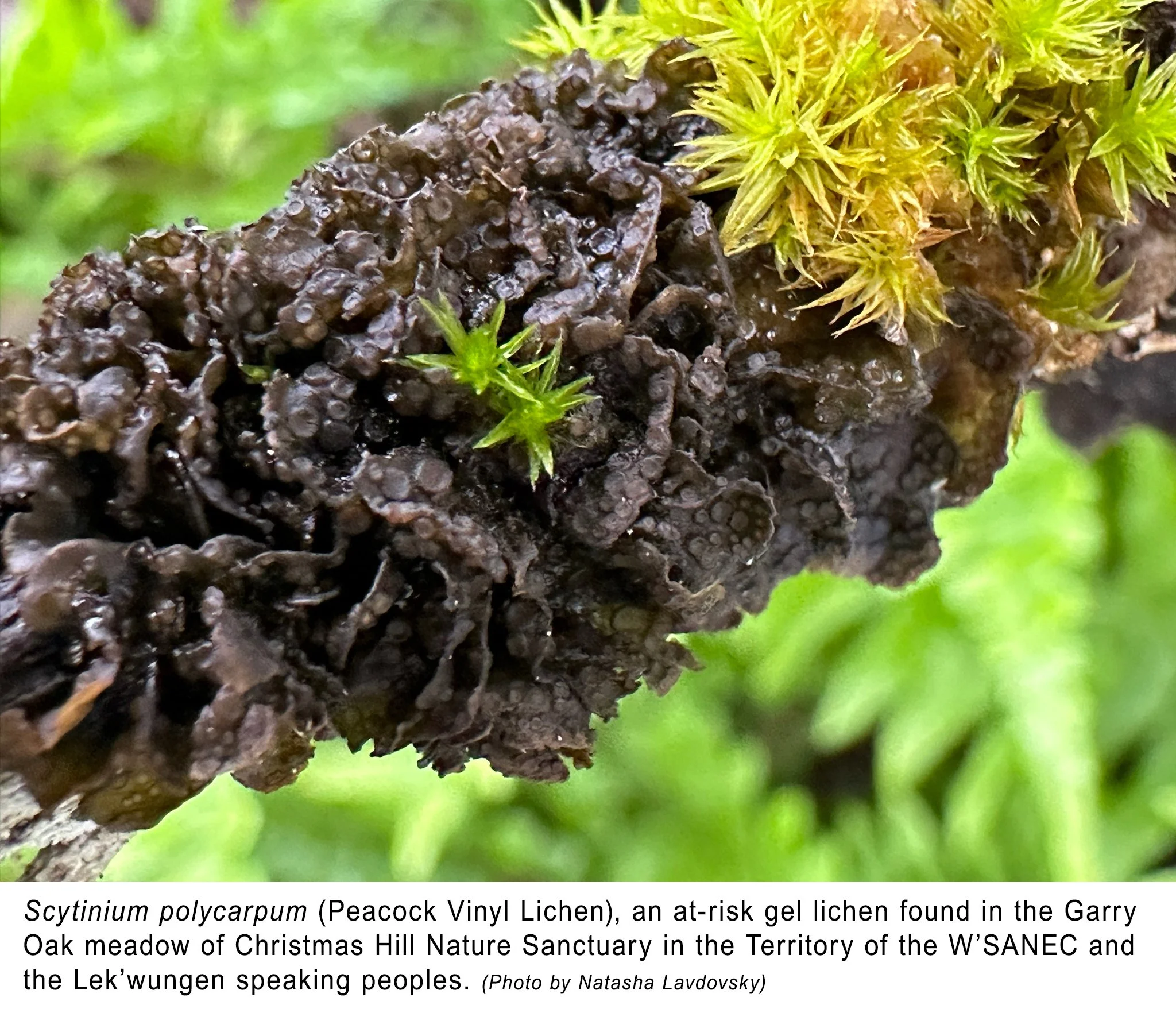
Unsurprisingly, there are endangered lichen species (red-listed) and lichen species of special concern (blue-listed) in Garry Oak ecosystems as well. These are the enigmatic gel lichens, Scytinium polycarpum (the blue-listed Peacock Vinyl Lichen) and Scytinium platynum (the endangered Batwing Vinyl Lichen). There are a number of more common gel lichens that grow in the same habitat on the same substrate as these two at-risk species so figuring out how to differentiate them all can take some time, and often requires a compound microscope and thin sections. Gel lichens’ internal structure is another example of how diverse and rule-breaking lichens can be. Instead of the fungus keeping the photobiont in a layer near the surface as is the case with most lichens, gel lichens (whose photosynthesizing partner is always the cyanobacteria Nostoc) have the cyanobacteria mixed with fungal hyphae throughout the lichen thallus— in other words, gel lichens have no internal stratification. Learning how to identify gel lichens could maybe be even more helpful to Garry Oak ecosystems than identifying other kinds of lichens. If we are lucky, maybe the presence of one of these endangered gel lichens might have the potential to halt urban development of a Garry Oak meadow—unlike the way tenured industrial forestry has no legal obligation to adjust their plans to the presence of at-risk lichen species. However, there are so many at-risk meadow species in Garry Oak ecosystems that it might be wise to not venture off trail in search of rare lichens, since we’re more likely to trample rare flowers than find the Batwing Vinyl Lichen.
The power of citizen science, moving slowly, looking closely, networking with specialists and with people who are spending time in the woods to steward the ecosystem, all comes together to create a powerful force that can give back to the land and embody reciprocity. In a way, it is kind of like a lichen— many beings coming together, being patient, sharing our specialties and gifts, building something that is helpful to the environment, and bigger than the sum of our parts. As we start to develop our lichen eyes, we see how the species diversity of our shared homes, from the Garry Oak meadows to the ancient temperate forests, are even more complex than we might have initially realized. What a magical world it is indeed!
To learn more about lichens reach out to artist/aspiring lichenologist Natasha Lavdovsky HERE to sign up for a lichen ID workshop, buy a lichen ID booklet digital download, purchase a Lichen Cult zine, or be added to their email list to be notified about local lichen events!